Yongsan Garrison
Yongsan Garrison has a long and militarized past. First occupied by the Japanese, the U.S. military assumed command during the Korean War. Bombing in central Seoul destroyed the former Japanese base. A city ravaged by civil war, the new American base was “originally surrounded by dirt roads and farming villages.”
1950: American forces move into Yongsan Garrison
2017: Construction begins on the park
2017: High levels of groundwater contamination are reported in and around the base
2018: Partial ownership of the base transfers to South Korea
2018: The base was opened to the public for the first time in over 100 years
2023: The U.S. has returned only 31% of the base to South Korea
Timeline
Deployments to South Korea are considered hardship missions, and the military quickly learned that soldiers would better endure these missions if their families were with them. However, the engineers’ directive was clear: “The first goal, keeping U.S. forces ready to fight, could not be allowed to fail. The second goal, providing comfortable living for U.S. personnel and families, was not as clear-cut.” As late as 1969, soldiers’ children were attending school in Quonset huts.
Yongsan Garrison became "a city within a city" during its nearly 70-year tenure
with its own housing, hotel, hospital, fire station, police force, chapel, department store, school system, movie theater, restaurants, sports facilities, and even an Olympic-sized pool. In total, the Garrison employed more than 10,000 military and civilian personnel with 30,000 total residents.
Meanwhile, outside the barbed-wire fences and guardshacks, South Korea’s economy was booming. Located just north of the Han River in a densely populated urban area, the base became “engulfed by high-rises and trendy stores as Seoul grew into an economic powerhouse.” The single-family homes, often outfitted with yards, playgrounds, and barbeque areas, compared starkly with the highrises surrounding it. In 1992, 77 acres of land was returned, upon which a family park and the National Museum of Korea were built. In 2009, both countries agreed to relocate troops and return Yongsan to South Korean ownership. Nearly a decade later, part of the base was transferred to the South Korean government and it was opened to the public for the first time since 1910. In 2018, construction began, with the ultimate goal to turn it into the country’s first national park—a once-in-a-lifetime opportunity to reintroduce nature and life into the city.
West 8 and Iroje, the landscaping and architecture firms undertaking this project acknowledge the irony in deconstructing an active urban space and building a park in its place. While some advocated for building housing in the space, the rationale for the park encompasses history, culture, and nature. Planning documents express a strong desire to remediate the, “deformed traces left behind by the foreign military for countless years.” In doing so, the city can heal from over a century of military occupation. Their plan for the park includes:

Move the slider to see the changes
Acknowledge history
- Restore select military buildings
- Stone posts placed at key points where the landmark buildings used to be
- Remodel select buildings into exhibition spaces and mini-museums
Reintroduce nature
- Construct streams, ponds, marshland, and lotus basins
- Restore hills and natural terrain central to South Korean geography
- Plant forests and woodlands
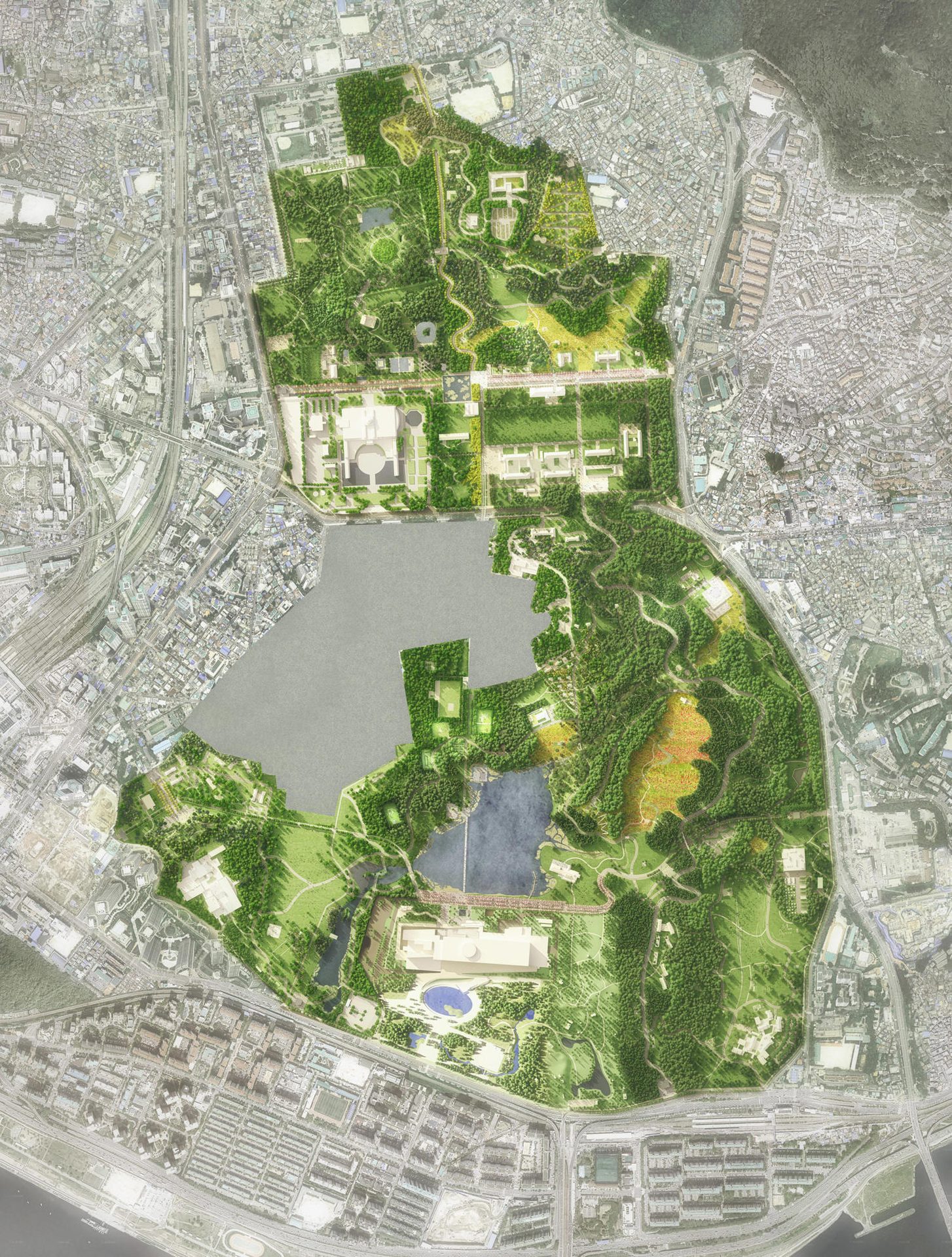

Connect to the city
- Build pedestrian bridges
- Connect to the War Memorial Museum, which abuts the base
- Connect to subway and other public transportation
Bring up to speed
- Build “Madangs”: open plazas designed for social activity and specific to Korean culture
Construction delays
Work on the park is contingent upon American transfer of ownership, which hinges on construction of a new base north of Seoul.
Groundwater remediation
Studies conducted by South Korea’s Ministry of Environment indicated high levels of groundwater contamination in and around the base. Local environmental organizations reported oil leaks in more than 100 spots.
Soil remediation
The soil in and around the base was found to contain soil contaminants like benzene, toluene and ethylbenzene above acceptable limits.
Obstacles
Yongsan Park is just one example of what happens to thousands of former U.S. military bases around the world. What about the rest?
NEXT CASE STUDY
GO BACK